Do private jets have Wi-Fi?
By Jake Lombardi. Published . 6 min read.
The short answer
Many do, but Wi-Fi belongs to the aircraft, not to private flying. Gogo's air-to-ground systems cover the contiguous US and parts of Canada and end about 100 miles offshore; satellite systems such as Starlink, Viasat and Gogo Galileo work over oceans. FCC rule 47 CFR 22.925 bans cellular calls in flight, and on a charter the operator decides which devices you may use.
On this page
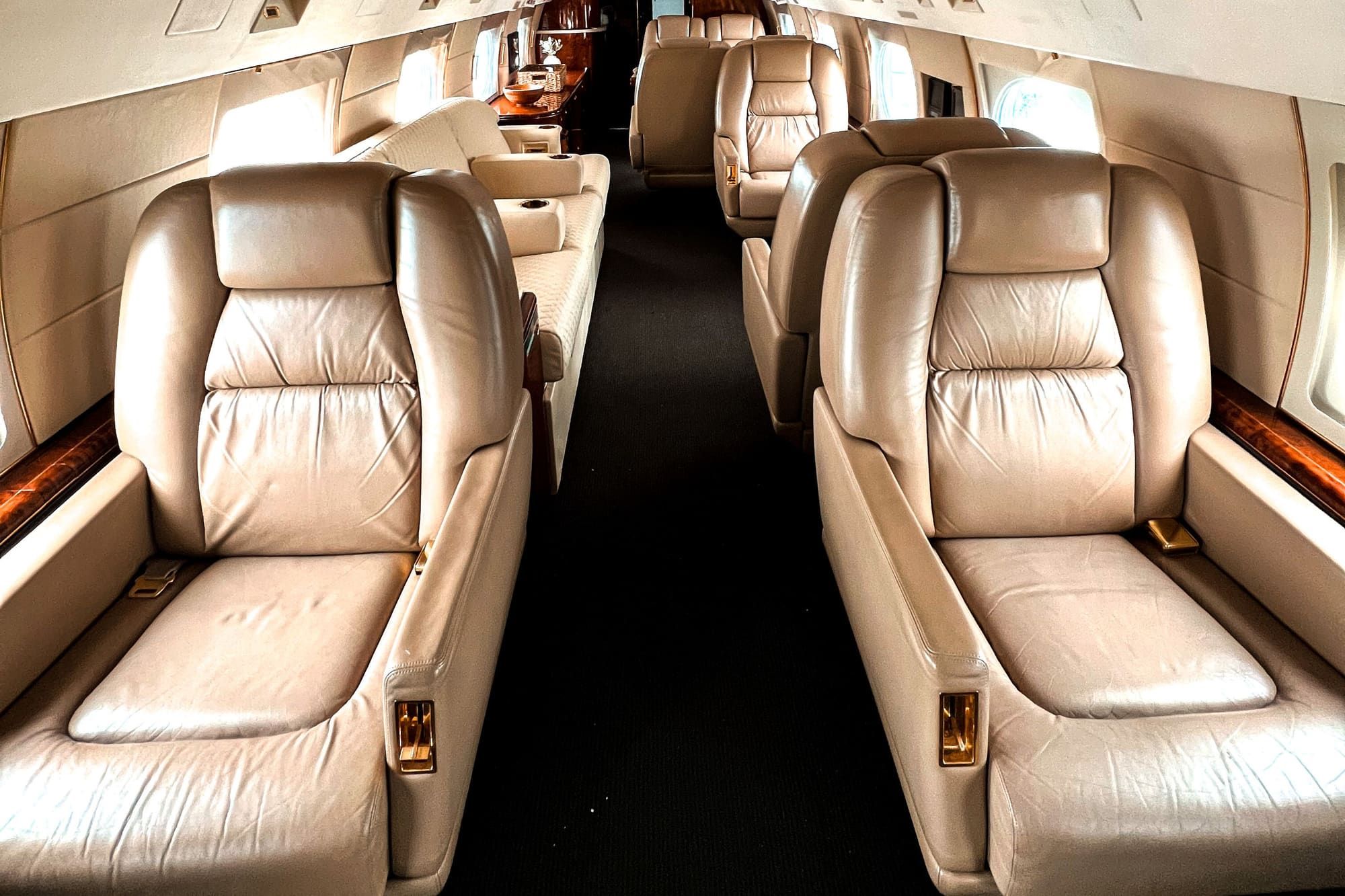
Wi-Fi is not a feature of private flying. It is a feature of a particular aircraft. Two jets of the same model on the same ramp can have entirely different connections, or none, and a system that streams video over Ohio can go silent 100 miles past the coast. So the useful question is not “do private jets have Wi-Fi” but “what is installed on the aircraft in my quote, and does it cover my route.”
This page explains the two kinds of system, where each works, what the vendors themselves say about speed, what the federal rules say about phones and devices, and what to ask before you book. Lombardi Jet Services is a broker; it arranges charters on aircraft operated by Part 135 certificate holders, and the connectivity on any trip is the operator’s equipment.
The short version
- Wi-Fi depends on the aircraft. It is fitted jet by jet. The quote should name the aircraft, and its equipment list says what connection it has.
- Air-to-ground stops at the coast. Gogo’s ground network covers the contiguous US and parts of Canada, and NBAA says such coverage “typically ends around 100 miles offshore”.
- Satellite works over oceans. Starlink, Viasat and Gogo’s Galileo use satellites; Gogo describes Galileo as “global coverage including polar routes”.
- Cell calls are banned in flight. Under 47 CFR 22.925, cellular telephones aboard an aircraft “must not be operated while such aircraft are airborne”.
- The operator decides which devices you may use. On a charter, 14 CFR 135.144 gives that decision to the certificate holder.
What kinds of Wi-Fi do private jets have?
Two kinds: air-to-ground, which talks to towers on the ground, and satellite, which talks to satellites overhead. The difference decides where your connection works.
Air-to-ground (ATG) is Gogo’s main business aviation network in North America. Gogo’s own product page says its Avance L5 and L3 systems give “complete coverage across CONUS and parts of Canada via the Gogo Biz ATG network”, and that its newer LX5 runs on “the revolutionary Gogo 5G network” with “speeds up to 80 Mbps”. Gogo describes L5 as giving “full internet access, multi-user connectivity, and reliable video calling” and L3 as handling “emails, text messages, and phone calls, while enjoying light internet usage”. It publishes no speed figure for L5 or L3 on that page.
Satellite systems work wherever their satellites reach. Gogo’s Galileo uses low-earth-orbit satellites and “operates independently of Gogo’s ATG networks”. Viasat describes its Ka-band service as delivering “uncapped speeds, extensive capacity, global coverage”. Starlink sells a business aviation service on the same principle; we could not read Starlink’s own plan pages, which load only in a browser, so its figures below come from trade reporting.
The table compares the systems a charter quote is most likely to mention, using each vendor’s own description where one is published.
Where does private jet Wi-Fi stop working?
At the edge of the network. NBAA’s November 2025 guide for passengers says that “since ATG systems require ground-based stations, their coverage area typically ends around 100 miles offshore of the U.S.” A jet with only an air-to-ground system will connect from Teterboro to Palm Beach or Van Nuys, and lose it over the water on the way to London, St. Barths or Nassau.
That makes the route, not the aircraft class, the first question. For a domestic trip an ATG system is usually enough. For any ocean crossing, the aircraft needs a satellite system, and that has to be confirmed for the specific jet.
How fast is Wi-Fi on a private jet?
As fast as the system and the number of people sharing it allow. The figures vendors publish are peak or “up to” speeds:
- Gogo LX5 on Gogo 5G: “speeds up to 80 Mbps”, in Gogo’s words, and “peak 80Mbps”.
- Gogo L5 and L3: no figure on Gogo’s current page; Gogo positions L5 for video calls and L3 for email and light use.
- Starlink: trade reporting in July 2026 said speeds of up to 1 Gbps apply to its top plan with a new high-performance antenna. We could not confirm that from Starlink.
Gogo 5G is new. Gogo’s second-quarter 2026 results say 138 Gogo 5G units were sold in that quarter, up from 52 in the first, with 38 aircraft online at June 30, 2026. On its November 6, 2026 earnings call, as transcribed by The Motley Fool, Gogo said it ended the third quarter with 94 aircraft online. Ninety-four aircraft is a small installed base, so few charter jets will have Gogo 5G yet.
Why do some charter jets not have Wi-Fi?
Cost, mostly. Holstein Aviation, an aviation consultancy, reported on July 15, 2026 that installing Starlink Aviation on a business jet “now runs approximately $200,000, up from $145,000 previously”, and that the top unlimited plan was “doubling from $10,000 to $20,000 per month”, with a regional 25 GB plan at $4,000 a month and a regional unlimited plan at $12,500. Those are trade figures, not Starlink’s published price list, but they show why an owner of a light jet flying short domestic legs may not fit satellite service at all.
The market is also mixed. NBAA’s guide cites 2024 data from Valour Consultancy on active terminals on business jets and turboprops: Iridium 40%, Gogo 33% and Viasat 24%. A terminal counted in that data is not necessarily cabin Wi-Fi fast enough for video, so the share tells you little about any one aircraft.
Can you use your phone on a private jet?
For data over the aircraft’s Wi-Fi, usually yes; for a cellular call, no. Two separate rules apply.
The FCC’s rule is about the cellular network. 47 CFR 22.925 reads:
Cellular telephones installed in or carried aboard airplanes, balloons or any other type of aircraft must not be operated while such aircraft are airborne (not touching the ground). When any aircraft leaves the ground, all cellular telephones on board that aircraft must be turned off.
The FAA’s rules are about interference with the aircraft. 14 CFR 91.21 bars portable electronic devices on aircraft flown by certificate holders, or under instrument flight rules, except those the operator “has determined will not cause interference with the navigation or communication system”. For a charter, 135.144 puts that determination with “that part 119 certificate holder operating the aircraft”. In practice that means the crew’s briefing tells you what may be used and when, and your phone stays in airplane mode with Wi-Fi switched on.
What should you ask before booking?
Four questions, each answered from the specific aircraft, not the model:
- Is a connection installed, and which system? The answer should name it: Gogo L3, L5 or LX5, Galileo, Starlink, Viasat or another.
- Does it cover the whole route? An ATG-only aircraft will not connect over an ocean.
- Is it working on this aircraft now? An installed system is only useful if it is serviceable on the day.
- Is use included in the price, or billed afterwards? Terms differ by operator.
How Jake works
Lombardi Jet Services is a broker, so it does not fit or run any aircraft’s connectivity. Every quote names the operator and the aircraft, and Jake deals directly with the certificate holder, so the system on board and whether it covers your route can be confirmed with the operator before you accept the quote. If Wi-Fi matters to the trip, say so when you ask for the quote, so it is one of the things checked.
Priced per trip, no memberships or jet cards: request a quote or call +1 (862) 485-3510.
Private jet Wi-Fi systems compared
What a quote may name, how each system connects, and whether it works over an ocean.
| System | How it connects | Coverage, in the vendor’s words | Over an ocean? | Speed or positioning stated |
|---|---|---|---|---|
| Gogo Avance L3 | Air-to-ground towers | CONUS and parts of Canada | No (ends about 100 miles offshore) | Email, texts, phone calls, light internet |
| Gogo Avance L5 | Air-to-ground towers | CONUS and parts of Canada | No (ends about 100 miles offshore) | Full internet, multi-user, video calling |
| Gogo Avance LX5 (Gogo 5G) | Air-to-ground towers | Nationwide plus parts of Canada | No (ends about 100 miles offshore) | Up to 80 Mbps |
| Gogo Galileo | Low-earth-orbit satellites | Global, including polar routes | Yes | No figure on Gogo’s page |
| Starlink Aviation | Low-earth-orbit satellites | Not read from Starlink | Yes | Up to 1 Gbps on the top plan (trade report) |
| Viasat (Ka-band) | Satellites | Global coverage | Yes | “Uncapped speeds” (no figure) |
More questions people ask
Can I make a phone call on a private jet?
Not on the cellular network. FCC rule 47 CFR 22.925 says cellular telephones aboard any aircraft must not be operated while it is airborne. A call over the aircraft's Wi-Fi, using an app, is a different matter: on a charter the operator decides under 14 CFR 135.144 which devices may be used, and Gogo describes even its entry-level L3 system as handling phone calls.
Does Wi-Fi work on a flight to Europe or the Caribbean?
Only if the aircraft has a satellite system. NBAA says air-to-ground coverage typically ends around 100 miles offshore of the United States, so a jet with only a Gogo air-to-ground system loses its connection over the Atlantic or most of the way to the islands. Ask whether the quoted aircraft has Starlink, Viasat, Gogo Galileo or another satellite service.
Is Starlink better than Gogo on a private jet?
They do different jobs. Gogo's air-to-ground network covers the contiguous United States and parts of Canada, and Gogo states up to 80 Mbps on its newest 5G system. Starlink is a satellite service that works over oceans; trade reports in July 2026 put its unlimited business aviation plan at $20,000 a month. For a domestic trip either can serve; for an ocean crossing only a satellite system works.
Do light jets have Wi-Fi?
Some do and some do not. Connectivity is fitted aircraft by aircraft, and the cost of a satellite installation, reported at about $200,000 for Starlink in 2026, means smaller and older jets are less likely to have it. The only reliable answer is the equipment list for the specific aircraft in your quote.
Is private jet Wi-Fi secure for work?
It is a shared network on the aircraft, run by the operator's chosen provider, so treat it as you would hotel Wi-Fi: use your company's VPN. We have not found a rule that sets security standards for cabin Wi-Fi on charter aircraft.
Sources
- eCFR: 47 CFR 22.925, Prohibition on airborne operation of cellular telephones (accessed November 15, 2026)
- eCFR: 14 CFR 91.21, Portable electronic devices (accessed November 15, 2026)
- eCFR: 14 CFR 135.144, Portable electronic devices (accessed November 15, 2026)
- Gogo Business Aviation: Avance L5, L3 and LX5, and Galileo (accessed November 15, 2026)
- Gogo Inc., second quarter 2026 results, Form 8-K Exhibit 99.1 (August 6, 2026) (accessed November 15, 2026)
- Gogo Q3 2026 earnings call transcript (November 6, 2026), The Motley Fool (accessed November 15, 2026)
- Gogo completes acquisition of Satcom Direct (December 4, 2024) (accessed November 15, 2026)
- NBAA Business Aviation Insider: Inflight connectivity, what your principal passengers need to know (November/December 2025) (accessed November 15, 2026)
- Holstein Aviation: Starlink doubles business aviation pricing (July 15, 2026) (accessed November 15, 2026)
- Viasat: Business aviation connectivity (accessed November 15, 2026)
Related articles
- Do private jets have flight attendants?
Aircraft and flying
- Do private jets have bathrooms?
Aircraft and flying
- How high do private jets fly?
Aircraft and flying

Route guides
Flight times, prices and airport detail for trips where this applies.
- Teterboro to London
International
- Teterboro to St. Barths
Islands and coast
- Teterboro to Van Nuys
Coast to coast

Written by Jake Lombardi
Jake is the managing director of Lombardi Jet Services. He has spent 15 years in private aviation and has arranged more than 1,000 charters. He holds a CPA license, volunteers with Backpacks for Life and collects art and memorabilia. About Jake
Plan this trip with Jake
Tell Jake your dates and how many are travelling, and he will come back with options and one clear price.
Request a quoteCall Jake: +1 (862) 485-3510
Lombardi Jet Services is an air charter broker. It is not a direct air carrier and does not have operational control of any aircraft. Flights are provided by properly licensed direct air carriers (FAA Part 135 operators, or foreign equivalents), which keep operational control. We act as our clients' agent.