What happens if someone has a medical emergency on a private jet?
By Jake Lombardi. Published . 6 min read.
The short answer
The pilots handle it, and the pilot in command decides whether to divert. Most charter jets carry no flight attendant, and federal rules require no defibrillator or emergency medical kit on them: under 14 CFR 135.177 a first-aid kit is required only on charter aircraft with more than 19 passenger seats. Airlines must carry an AED under 14 CFR 121.803. Ask the operator what the aircraft carries before you fly.
On a charter jet, a medical emergency is handled by the two pilots, with whatever equipment the operator chose to put on board, and the captain decides whether to land early. That is different from an airliner in three ways: there is usually no flight attendant, there is usually no rule requiring a defibrillator or a medical kit, and a business jet can land at smaller airports than an airliner can.
Lombardi Jet Services is a charter broker. It arranges flights on aircraft operated by Part 135 certificate holders. This page sets out what the federal rules require on those aircraft, as published on eCFR on November 23, 2026, compares them with the airline rules, and lists what to ask before a trip with someone who has a medical condition.
The short version
- Airlines must carry a defibrillator; charter jets need not. 14 CFR 121.803 requires an AED on airliners with a flight attendant and more than 7,500 pounds of payload. We found no such rule in Part 135.
- A first-aid kit is required on charters only above 19 seats. 14 CFR 135.177 applies to aircraft with more than 19 passenger seats, which leaves out any charter jet configured for 19 or fewer.
- The pilots are the first responders. Part 135 training programs must cover “first aid equipment and its proper use” and passenger illness or injury, under 135.331. A flight attendant is required only above 19 seats.
- The captain decides whether to divert. Under 14 CFR 91.3, the pilot in command “is directly responsible for, and is the final authority as to, the operation of that aircraft.”
- Ask before you fly. What the aircraft carries is the operator’s choice, so ask what kit, whether there is an AED and whether the crew can call a doctor in flight.
Do private jets carry a first-aid kit?
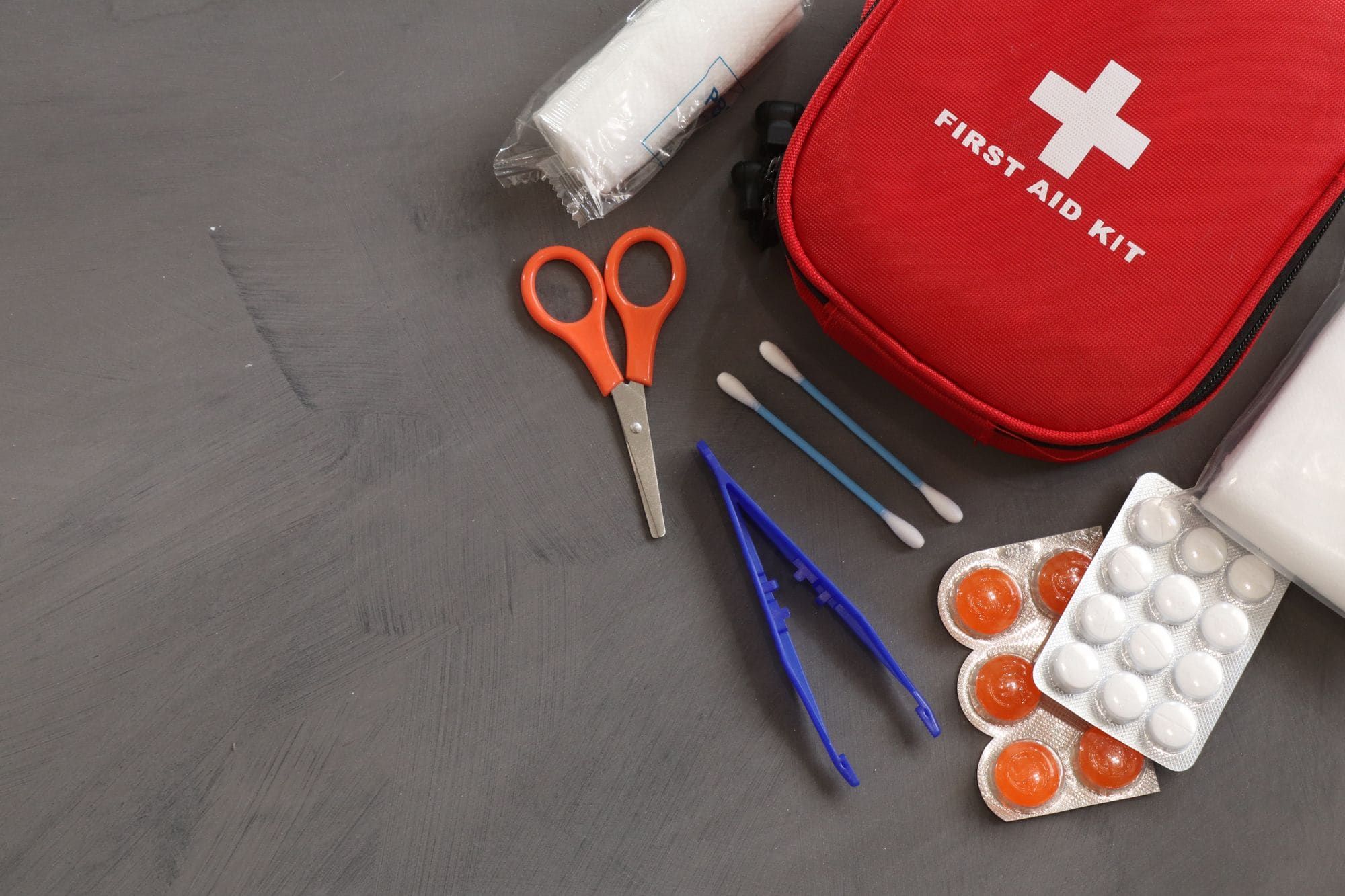
Not necessarily. The charter rules require one only on aircraft with more than 19 passenger seats. Section 135.177(a) applies to aircraft “having a passenger seating configuration, excluding any pilot seat, of more than 19 seats”. On those, the operator must carry “at least one approved first-aid kit for treatment of injuries likely to occur in flight or in a minor accident”, stored where crew can reach it. The rule lists its contents: 16 one-inch adhesive bandages, 20 antiseptic swabs, 10 ammonia inhalants, eight 4-inch compresses, five triangular bandages, an arm splint, a leg splint, four roller bandages, two rolls of tape, scissors and one pair of gloves.
That is a kit for cuts and fractures. It holds no medicines.
For the light, midsize and large-cabin jets most people charter, configured with fewer than 20 seats, we found no section of Part 135 that requires a first-aid kit at all. A text search of the whole of Part 135 finds the phrase only in 135.177 and in the training rule. That does not mean the aircraft has nothing; it means what it has is the operator’s decision.
An owner flying their own jet is under a different rule. 14 CFR 91.513(d) says “First aid kits for treatment of injuries likely to occur in flight or in minor accidents must be provided” on large airplanes and turbojet-powered multiengine airplanes. Section 91.501(a) says those rules “do not apply to those aircraft when they are required to be operated under parts 121, 125, 129, 135, and 137”. The same jet can be required to carry a kit when its owner flies it and not when it flies you as a charter.
Do private jets have defibrillators?
Not by any rule we found for charter or private flights. The defibrillator rule is an airline rule. Section 121.803(c)(4) requires “an approved automated external defibrillator” on Part 121 airplanes “for which a flight attendant is required and with a maximum payload capacity of more than 7,500 pounds”. Section 121.803(c)(2) adds an approved emergency medical kit wherever a flight attendant is required.
The FAA’s Advisory Circular 121-33B says the same: “The FAA requires AEDs on all airplanes of air carriers operating under part 121 with a maximum payload capacity of more than 7,500 pounds and with at least one flight attendant.” It adds that the guidance “may also be valuable” to Part 135 operators. That is advice, not a requirement.
Some operators carry an AED and a medical kit anyway. The only way to know is to ask about the specific aircraft.
Who helps if there is no flight attendant?
The pilots, and anyone on board with medical training. A charter needs a flight attendant only when the aircraft has more than 19 passenger seats, under 14 CFR 135.107. Do private jets have flight attendants? explains that rule and what a cabin attendant does when one is booked.
What the pilots are trained to do is set by the operator’s training program. 14 CFR 135.331 requires emergency training to include “first aid equipment and its proper use” and “illness, injury, or other abnormal situations involving passengers or crewmembers.” It does not require a medical qualification.
Some operators also subscribe to a ground-based medical advice service. MedAire, one such provider, says its MedLink doctors “have full visibility of the medical supplies and equipment available onboard” and advise on whether to divert. Whether your aircraft has such a service is a question for the operator.
Who decides whether a private jet diverts?
The captain. Section 91.3(a) makes the pilot in command “the final authority as to the operation of that aircraft”, and 91.3(b) allows the pilot, in an in-flight emergency requiring immediate action, to “deviate from any rule of this part to the extent required to meet that emergency.” Passengers can ask for a diversion. They cannot order one.
A business jet can use shorter runways than an airliner, so the captain may have more airports to choose from; how much runway a private jet needs gives the distances by aircraft. The captain still has to weigh the runway, the weather, whether there is an ambulance service and, on an international flight, whether customs can receive the aircraft.
What should you arrange before a trip with a medical risk?
Four things, at booking:
- Tell the operator about the condition. Not the details, unless you want to, but enough for them to say whether this aircraft and crew are suitable.
- Ask what is on board. A first-aid kit, a medical kit, an AED, oxygen for passengers. Ask for the answer for the specific aircraft on the quote.
- Ask about medical advice in flight. Whether the crew can reach a doctor by phone or radio from the cockpit.
- Carry your own medicines in the cabin. Not in the hold. Planned oxygen, stretchers and air ambulances are covered in flying private with medical needs.
How Jake works
Jake uses operators rated ARGUS Gold or Platinum, confirmed before he quotes, and names the operator and the aircraft in the quote. He deals with the certificate holder, so a question about a medical kit, an AED or the crew’s training goes to the operator responsible for that aircraft.
Sources
- 14 CFR 135.177, emergency equipment for aircraft with more than 19 passenger seats (eCFR), accessed 23 November 2026
- 14 CFR 135.107, flight attendant requirement (eCFR), accessed 23 November 2026
- 14 CFR 135.331, crewmember emergency training (eCFR), accessed 23 November 2026
- 14 CFR 91.513, emergency equipment, and 91.501, applicability of subpart F (eCFR), accessed 23 November 2026
- 14 CFR 121.803, emergency medical equipment for airlines (eCFR), accessed 23 November 2026
- 14 CFR 91.3, responsibility and authority of the pilot in command (eCFR), accessed 23 November 2026
- FAA Advisory Circular 121-33B, Emergency Medical Equipment, accessed 23 November 2026
- MedAire: MedLink, accessed 23 November 2026
Medical equipment the rules require, by type of flight
What federal rules require on board. Operators can carry more; ask what the specific aircraft carries.
| First-aid kit | Medical kit or defibrillator | Flight attendant | |
|---|---|---|---|
| Charter jet (Part 135), 19 passenger seats or fewer | None found in Part 135 | None found | Not required (135.107) |
| Charter aircraft (Part 135), more than 19 seats | Required, with listed contents (135.177(a)(1)) | None found | Required (135.107) |
| Private jet flown by its owner (Part 91 subpart F) | Required (91.513(d)) | None found | No rule found |
| Airline (Part 121) | Required (121.803(c)(1)) | Medical kit where a flight attendant is required; defibrillator also above 7,500 lb payload (121.803(c)(2) to (4)) | Required by seats and payload |
More questions people ask
Can I ask the operator to put a defibrillator or medical kit on board?
Yes, and the time to ask is when the trip is booked, not at the aircraft. The operator decides what the aircraft carries and whether its crew is trained to use it. If someone travelling has a known heart or medical condition, say so when you ask, so the operator can answer for that aircraft and crew.
Can a doctor travelling with us use their own equipment?
Ask the operator first. Medical devices and medicines carried in the cabin go through the operator, and oxygen and battery-powered devices have their own rules. Our page on flying with medical needs covers portable oxygen concentrators and oxygen cylinders.
Do airline rules on defibrillators apply to charter jets?
No. 14 CFR 121.803 applies to airlines operating under Part 121. It requires an approved emergency medical kit where a flight attendant is required, and a defibrillator where a flight attendant is required and the maximum payload is more than 7,500 pounds. The FAA's AC 121-33B says that guidance 'may also be valuable' to Part 135 operators, which is not a requirement.
Is a privately owned jet required to carry a first-aid kit?
Yes, if it is a large airplane or a turbojet-powered multiengine airplane flown under Part 91 subpart F. 14 CFR 91.513(d) says 'First aid kits for treatment of injuries likely to occur in flight or in minor accidents must be provided.' Subpart F does not apply when the same aircraft flies a charter under Part 135, under 91.501(a).
Who pays if a charter flight diverts for a medical emergency?
That depends on the charter contract. A diversion adds flight time, landing and handling fees, and may push the crew toward its duty limits, which can mean an overnight. Read the contract's terms on diversions and additional charges before you sign, and ask the broker to point to them.
Sources
- 14 CFR 135.177, Emergency equipment requirements for aircraft having a passenger seating configuration of more than 19 passengers (eCFR) (accessed November 23, 2026)
- 14 CFR 135.107, Flight attendant crewmember requirement (eCFR) (accessed November 23, 2026)
- 14 CFR 135.331, Crewmember emergency training (eCFR) (accessed November 23, 2026)
- 14 CFR 91.513 and 91.501, emergency equipment for large and turbine-powered multiengine airplanes (eCFR) (accessed November 23, 2026)
- 14 CFR 121.803, Emergency medical equipment (eCFR) (accessed November 23, 2026)
- 14 CFR 91.3, Responsibility and authority of the pilot in command (eCFR) (accessed November 23, 2026)
- FAA Advisory Circular 121-33B, Emergency Medical Equipment (2006) (accessed November 23, 2026)
- MedAire: MedLink (accessed November 23, 2026)
Related articles
- ARGUS, Wyvern and IS-BAO ratings
Safety and trust
- Is flying private safer than commercial?
Safety and trust
- How to spot a private jet charter scam
Safety and trust


Written by Jake Lombardi
Jake is the managing director of Lombardi Jet Services. He has spent 15 years in private aviation and has arranged more than 1,000 charters. He holds a CPA license, volunteers with Backpacks for Life and collects art and memorabilia. About Jake
Plan this trip with Jake
Tell Jake your dates and how many are travelling, and he will come back with options and one clear price.
Request a quoteCall Jake: +1 (862) 485-3510
Lombardi Jet Services is an air charter broker. It is not a direct air carrier and does not have operational control of any aircraft. Flights are provided by properly licensed direct air carriers (FAA Part 135 operators, or foreign equivalents), which keep operational control. We act as our clients' agent.